4.1 NF-κB Signalling in Blood Cancer & Systems Biology#
Modelling Signalling — Computational Modelling SSC (Week 4) Mitchell Lab, Brighton and Sussex Medical School
Click 📽️ Present Slides above to step through this session slide-by-slide in class, or scroll down to read at your own pace before launching the live NF-κB simulations.
Overview: Zooming Into the Cell#
Previously:
We modelled infectious disease spread across whole populations (SI/SIS, SIR/SIRS, Endemic SIR, SEIR).
You explored molecular dynamics at the atomic and protein scale.
Today:
We zoom to the cellular signalling scale—modelling how biochemical networks inside B-cells control survival, proliferation, and drug responses in blood cancer!
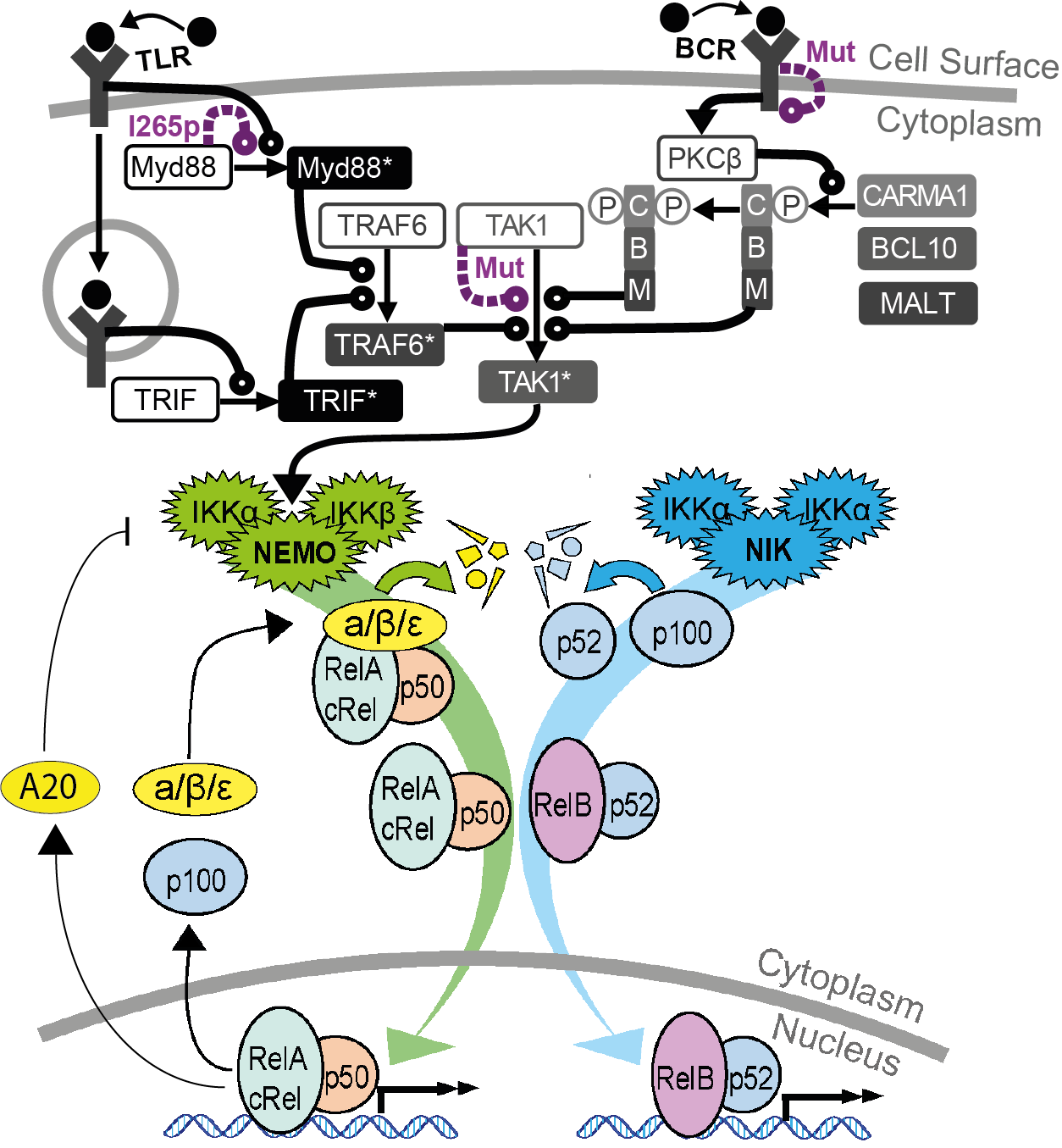
Clinical Motivation 1: Waldenström Macroglobulinemia (WM)#
A rare B-cell lymphoma driven by hyperactive NF-κB signalling.
98% of WM patients carry the MYD88 L265P mutation, which locks the TLR adaptor protein MYD88 into a constitutively active (
MYD88*) state—even without an external pathogen signal!Current treatments: BTK inhibitors (e.g. ibrutinib/zanubrutinib), proteasome inhibitors, chemotherapy, and rituximab.
The clinical challenge: Survival improvements over recent decades have slowed, resistance develops, and new targeted therapies are needed (Yin et al., Frontiers in Oncology, 2020).
Look Ahead to Your Practical Challenge
In 4.3 Drug Discovery for Waldenström Macroglobulinemia, you will switch on the MYD88 L265P mutation (k1_MYD88SELFACTIVATION-TLR = 1.0) in our virtual B-cell and screen candidate drugs to try to restore healthy signalling!
Clinical Motivation 2: Chronic Lymphocytic Leukaemia (CLL)#
The most common adult leukaemia in the Western world—still incurable with standard therapies.
Patients fall into two major prognostic groups depending on immunoglobulin mutational status:
Mutated CLL (M-CLL): Lower basal B-cell receptor (BCR) signalling and more indolent course.
Unmutated CLL (U-CLL): Chronic, elevated BCR signalling activity and significantly worse prognosis (shorter time to treatment and reduced survival).
Clinical Motivation 3: Diffuse Large B-Cell Lymphoma (DLBCL)#
The most common aggressive blood cancer—and highly heterogeneous across patients.
Genetic subtypes (such as ABC-DLBCL / MCD) carry recurrent mutations across the entire NF-κB network:
MYD88 L265P (TLR pathway)
BCR / CD79B (BCR pathway)
CARMA1 / CBM complex & TAK1 (upstream signalling hub)
A20 (TNFAIP3) loss (loss of negative feedback!)
Many drugs target NF-κB signalling, yet patients with NF-κB pathway mutations still have worse prognosis—highlighting why we need quantitative models to predict which drug works for which mutation.
Why We Need to Understand NF-κB#
Ubiquitous transcription factor: Expressed in almost every cell in the human body, making direct inhibition very hard to drug safely without severe off-target toxicity.
Controls critical cell fates: Drives cell survival and cell division (bad when hijacked by lymphoma cells) and is essential for normal immune responses.
Two interconnected pathways (O’Donnell, Pepper, Mitchell & Pepper, Frontiers in Oncology, 2023):
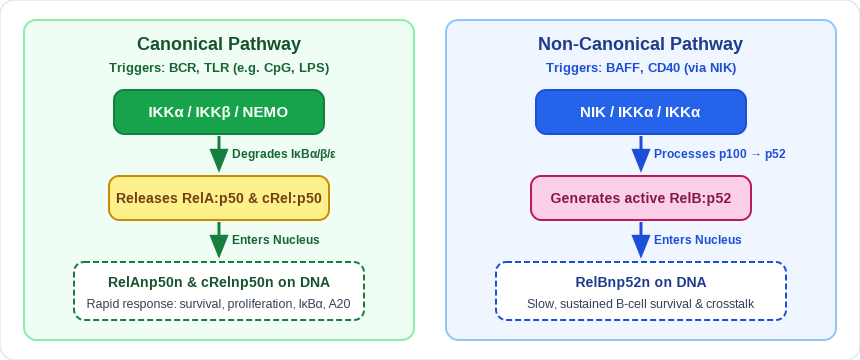
Very complicated! Positive feedback, delayed negative feedback (IκBα and A20), receptor crosstalk via shared TAK1, and multiple NF-κB dimers (RelA:p50, cRel:p50, RelB:p52) interact simultaneously (Mitchell, Tsui, Tan, Pack & Hoffmann, Science Signaling, 2023).
What Is Systems Biology?#
How can anyone make sense of a network with more than 100 interacting proteins and reactions? Systems biology follows a clear, repeatable scientific loop (Mitchell & Hoffmann, Methods in Molecular Biology, 2015):
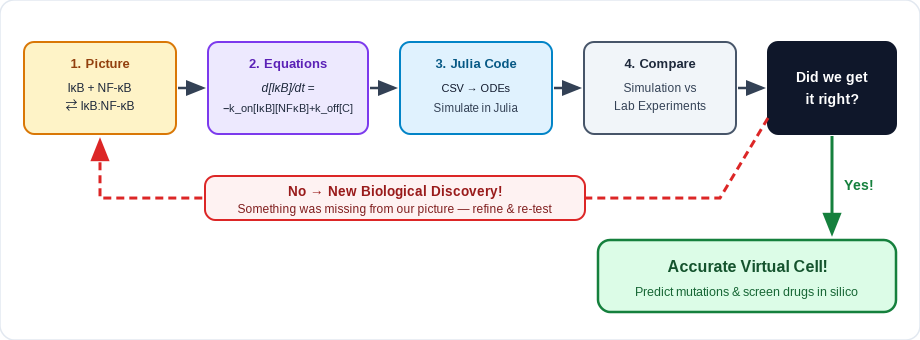
It starts with a picture: Draw the biochemical interaction—for example, inhibitor IκB binding to NF-κB with association rate \(k_{\text{on}}\) and dissociation rate \(k_{\text{off}}\): $\(\text{I}\kappa\text{B} + \text{NF}\kappa\text{B} \underset{k_{\text{off}}}{\overset{k_{\text{on}}}{\rightleftharpoons}} \text{I}\kappa\text{B}\text{–}\text{NF}\kappa\text{B}\)$
We write some equations: Translate the arrows directly into a rate-of-change equation (ODE): $\(\frac{d[\text{I}\kappa\text{B}]}{dt} = \underbrace{-k_{\text{on}}[\text{I}\kappa\text{B}][\text{NF}\kappa\text{B}]}_{\text{Goes down as I}\kappa\text{B}\text{ binds NF}\kappa\text{B}} \;+\; \underbrace{k_{\text{off}}[\text{I}\kappa\text{B}\text{–}\text{NF}\kappa\text{B}]}_{\text{Goes up as complex dissociates}}\)$
We turn the equations into code:
delta(IkB) = -kon * IkBa * NFkB + koff * IkBaNFkB
(In our large model,
csv2model-multiscale.pyautomatically generates all 140+ Julia ODEs from clean CSV reaction tables!)We simulate the system in Julia: Compute how nuclear NF-κB rises and falls over minutes to hours under different stimuli (e.g. TNF vs LPS).
We compare simulations to lab experiments (Mitchell et al., Frontiers in Immunology, 2019).
Did we get it right?
No? Even better—we have discovered that something was missing from our biological picture! (e.g. Roy, Mitchell et al., Immunity, 2019 discovered a key regulatory circuit controlling cRel dynamics in B-cell differentiation).
Yes? We have created an accurate virtual cell that can predict mutation effects and screen drugs in silico!
Applying This Approach to Blood Cancer#
Our B-cell NF-κB Tri-Model was built up modularly over nearly a decade of published systems biology research:
Shokhirev … Hoffmann, Mol. Syst. Biol. (2015)
Mitchell*, Roy* … Hoffmann, PNAS (2018)
Roy*, Mitchell* … Hoffmann, Immunity (2019)
Cloete … Mitchell, npj Systems Biology and Applications (2023)
Jayawant … Mitchell, Frontiers in Oncology (2023)
Mitchell … Hoffmann, Science Signaling (2023)
Instead of hand-coding hundreds of tangled equations, the model is assembled from four clean CSV modules (BCR, TLR, NFkB, and linking) sharing the central kinase hub TAK1!
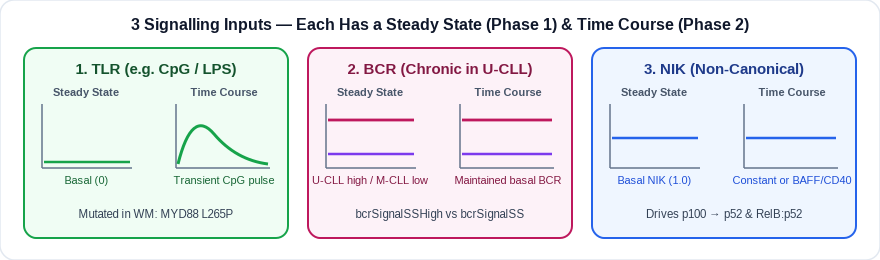
Three Inputs (Well, Six Really!)#
Every simulation runs in two phases:
Steady State (Phase 1 — 1,000 hours): The virtual B-cell sits in its resting or chronic disease environment (e.g. low basal BCR in M-CLL vs elevated chronic BCR in U-CLL) until all 140 species reach equilibrium.
Time Course (Phase 2 — 12 hours): Starting from that exact steady state, we apply an acute microenvironment stimulus (such as a TLR / CpG pulse) and watch how nuclear NF-κB dimers respond!
Our Guiding Question for the Guided Practical
How do different levels of basal BCR signalling (M-CLL vs U-CLL) affect how a B-cell responds to TLR activation—and can an IKK inhibitor drug reverse it?
Ready for the Practical Task!#
First half (together): In 4.2 Guided Practical: Simulating CLL & Drug Responses, we will assemble the full NF-κB Tri-Model live in Julia, simulate M-CLL, U-CLL, and U-CLL + IKK inhibitor, and interpret the resulting nuclear NF-κB plots.
Second half (your challenge): In 4.3 Drug Discovery for Waldenström Macroglobulinemia, you will turn on the MYD88 L265P mutation and test candidate targeted drugs to find effective therapies for Waldenström Macroglobulinemia!