1.1 Introduction to Computational Modelling#
Modelling Across Scales: From Molecules to Pandemics SSC Intro and Overview — Dr Simon Mitchell, Brighton and Sussex Medical School
Use the 📽️ Present Slides button above to step through this introduction slide-by-slide in class, or scroll straight down to read at your own pace.
Thank You for Choosing This SSC!#
Part taught, part interactive — we explain the biology and core concepts, then immediately test them together using live computer simulations.
Research-led — every modelling approach you try here is actively used in biomedical and clinical research.
No coding or maths knowledge required — we will walk through every equation and line of code together in plain English so you can see how things work without getting bogged down in jargon.
Interactive in your browser — every simulation runs live on the Mitchell Lab compute server, so you can experiment freely, break models, and reset whenever you like.
Meet the Teaching Team#
Our research group focuses on computational systems biology and medicine — trying to understand biology, disease, and treatment using computational simulations (mitchell.science).
Prof Simon Mitchell — Systems biology, cancer signalling, and population/multi-scale modelling
Dr Tabea Fullstone — Computational biology & cell signalling
Class Warm-Up
Introduce yourselves! Share your name, what drew you to this SSC, and whether you’ve ever seen a mathematical or computational model used in medicine (or in the news!).
Modelling Across Three Biological Scales#
Throughout this SSC, we connect models spanning more than 15 orders of magnitude in size and time:
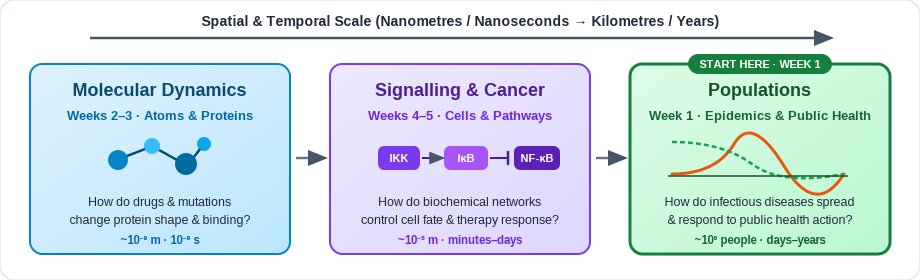
Molecular Dynamics (Weeks 2–3): Simulating individual atoms and proteins to see how mutations and drugs alter protein structure and binding.
Signalling & Cancer (Weeks 4–5): Modelling biochemical networks (such as NF-κB / IκB) inside cells to predict how cancer cells respond to therapy.
Populations (Week 1 — today!): Modelling how infectious diseases spread across millions of people and how public health interventions reshape an outbreak.
Why Modelling Matters in Medicine#
Timely! During COVID-19, compartmental epidemic differential equations appeared directly on national television (such as BBC News broadcasts) to explain lockdowns, transmission rates, and hospital capacity.
Key to every aspect of medicine — from early drug discovery to public health policy.
The future of medicine? Personalised medicine relies on patient-specific computational models to predict which therapy will work best for an individual.
Active research area — rapidly expanding across cardiology, oncology, immunology, and epidemiology.
Quicker, cheaper—and sometimes more accurate—than animal models:
For example, in Scientific American (“Should Computer Simulations Replace Animal Testing for Heart Drugs?”, Passini, Rodriguez & Benito, 2018), computational models of human heart cells showed higher accuracy than animal models in predicting dangerous drug-induced arrhythmias.
Learning Outcomes#
By the end of this SSC, you will be able to:
Understand how computers and mathematics are used to simulate biology and how that is useful for medicine.
Run and modify computational models of biological systems across multiple scales (populations, cellular signalling, and molecular dynamics).
Present and critically evaluate results generated from simulations—articulating both the insights they provide and the limitations of modelling.
Assessment: 6-Minute Presentations#
At the end of the SSC (Weeks 7–8), each student delivers a 6-minute presentation showcasing one modelling result using any of the techniques covered during the course:
Background: Briefly introduce the biology/clinical question and what you simulated.
Result & Interpretation: Show your simulation output and explain what it means biologically or clinically.
Limitations & Next Steps: Discuss what assumptions your model makes, where it might break down, and what you would add next.
Q&A: Answer a question or two from the group!
Tip
Tip for Assessment Ideas As we explore each model today (SI/SIS, SIR/SIRS, Endemic SIR, SEIR), pay attention to the challenges and discussion questions at the end of each section—many of them make excellent starting points for a 6-minute presentation!
Population-Scale Modelling in the Real World#
When an outbreak like COVID-19 hits, epidemiologists write down a compartmental differential equation model tracking how many people are in each disease state over time.
For instance, the real-world Wuhan COVID-19 model shown on BBC News (Lin et al., 2020, International Journal of Infectious Diseases, 93: 211–216) tracks Susceptible (\(S\)), Exposed (\(E\)), Infectious (\(I\)), Recovered (\(R\)), Population (\(N\)), Severe/Critical (\(D\)), and Cumulative cases (\(C\)):
That looks intimidating all at once! So how do modellers actually build something like this?
We start with the simplest possible version (just two boxes: Susceptible and Infectious) and add one biological feature at a time until we reach a full SEIR model!
Let’s dive into 1.2 The SI & SIS Model and run our first live epidemic simulation.