Modelling Across Scales: From Molecules to Pandemics#
Welcome to the Brighton and Sussex Medical School (BSMS) Student Selected Component (SSC) taught by the Mitchell Lab.
This interactive book combines our in-class lecture slides and live Julia & Python computational simulations in one place—no logins, software installation, or prior coding or mathematics background required.
Tip
Two Ways to Use This Book
📖 Reading Mode (default): Scroll through the explanations, diagrams, equations, 3D protein viewers, and pre-computed plots at your own pace, and click ⚡ Activate Live Editable Cells whenever you want to edit parameters and run live simulations in your browser.
📽️ Present Slides: Click 📽️ Present Slides (top toolbar or top-right header) to step section-by-section in full-screen slide view—ideal for presenting in class while running live simulations right on the projector. Press
Escor click 📖 Reading Mode at any time to return.
SSC Structure (8 Weeks)#
Across this SSC, we explore how computational simulations help us understand biology and medicine across three very different scales—from individual protein atoms up to entire human populations:
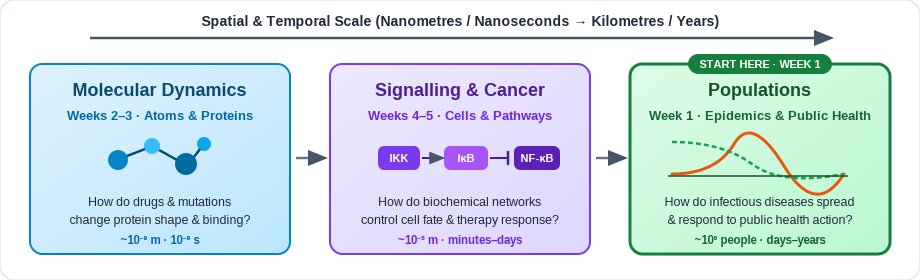
Week |
Topic |
Scale |
Language |
Status |
|---|---|---|---|---|
Week 1 |
Intro to Computational Modelling & Population-Scale Models (SI, SIS, SIR, SIRS, SEIR) |
Populations & Public Health |
Julia |
Live in this book |
Week 2 |
Molecular Dynamics I: Force Fields, Equations & Protein Structures ( |
Atoms & Proteins |
Python |
Live in this book |
Week 3 |
Molecular Dynamics II: Energy Landscapes, OpenMM Protein Folding & Analysis |
Atoms & Proteins |
Python |
Live in this book |
Week 4 |
Cell Signalling Modelling: NF-κB in Blood Cancer (CLL & Waldenström) |
Cells & Biochemical Networks |
Julia |
Live in this book |
Week 5 |
Cell Fate Modelling: Apoptosis (BCL2) & Cell Cycle (c-MYC) |
Cells & Biochemical Networks |
Julia |
Live in this book |
Week 6 |
Preparation for Assessment (no taught session) |
— |
— |
Independent project work |
Week 7 |
Assessment Week 1 (6-minute presentations — all attend) |
— |
— |
Presentation |
Week 8 |
Assessment Week 2 (6-minute presentations — all attend) |
— |
— |
Presentation |
Start Exploring#
Week 1 — Introduction & Population-Scale Modelling (Julia)#
1.1 Introduction to Computational Modelling — Overview, learning outcomes, and real-world outbreak ODEs
1.2 The SI & SIS Model — Your first two-compartment outbreak model
1.3 The SIR & SIRS Model — Adding immunity and waning immunity
1.4 Endemic SIR: Births & Deaths — Population turnover and recurrent waves
1.5 The SEIR Model & Wrap-Up — Incubation periods, disease-induced mortality, and discussion
Week 2 — Molecular Dynamics I: Force Fields & Protein Structures (Python)#
2.1 Molecular Dynamics I: Force Fields, Equations & PDB Files — Protein structure, bonded & non-bonded force fields, Newton’s equations, ensembles, PBCs, and the RCSB PDB activity
2.2 Guided Activity: Exploring PDB Structures in Python — Parse
.pdbcoordinates, rotate 3D protein models (villin_water.pdb,polyALA.pdb,polyGLY.pdb), and build a custom 3D peptide spelling your own name
Week 3 — Molecular Dynamics II: Simulating & Analysing Protein Folding (Python)#
3.1 Molecular Dynamics II: Energy Landscapes & Trajectory Analysis — Energy barriers, the sampling problem, secondary structure (DSSP), H-bonds, Ramachandran plots, and RMSD
3.2 Live OpenMM Practical: Simulating Protein Folding — Simulate 200 ps of
polyALA.pdbfolding into an \(\alpha\)-helix at \(300\text{ K}\), watch the animated 3D trajectory, plot end-to-end distance & Ramachandran transitions, and test temperature, polyglycine, or your own name peptide
Week 4 — Cell Signalling Modelling: NF-κB in Blood Cancer (Julia)#
4.1 NF-κB Signalling in Blood Cancer & Systems Biology — WM, CLL, DLBCL, canonical vs non-canonical NF-κB, and the systems biology loop
4.2 Guided Practical: Simulating CLL & Drug Responses — Build the 140-species NF-κB Tri-Model and compare M-CLL, U-CLL, and IKK inhibition
4.3 Drug Discovery for Waldenström Macroglobulinemia — Switch on MYD88 L265P and screen targeted drugs & combinations
Week 5 — Cell Fate Modelling: Apoptosis & Cell Cycle (Norris et al., 2024 — Julia)#
5.1 Apoptosis, Cell Cycle & Double-Hit Lymphoma — Double-Hit Lymphoma, BCL2, c-MYC, and the Apoptosis & Cell Cycle networks
5.2 Apoptosis Modelling: BCL2 Delays Cell Death (Figure 1B) — Simulate the 59-species Apoptosis model, sweep BCL2 (1×–100×), and screen rescue genes
5.3 Cell Cycle Modelling: c-MYC Shortens G1 (Figure 1E) — Simulate the 37-species Cell Cycle model, prove G1 shortens with c-MYC, and rescue G1 shortening